Thursday, January 13, 2011

Chapter 8 Notes

Architecture Photography
  • Architectural photographyare like indirect portrait of the people who live in the buildings being photographed.
  • Architectural photography can be a visual recording of a buildings appearance or a casual "sketch" of a place and the emotions connected to that place.
  • Pattern, is usually a part of every image in architectural photography.
    • it enriches and strengthens photos by adding visual complexity.
  • Small f-stops give photos a greater depth of field, slower film gives more detail and the bigger the negative space in a photo the more detail captured.
  • Contrast is the difference or range of values.
  • Differences in tonal values accentuate texture.
  • Film (color) emphasizes the color and setting and is more commonly used in commercial photography in architectural photography, while (black & white) emphasizes value, shapes and texture and is commonly used in artistic architectural photography.
Big View
  • Wide angle lens is go to use
  • most commercial architectural photographs rely on it, shows the whole building
Perspective distortion - appears as strong converging lines in a building, where the sides of the building angle in towards each other instead of looking parallel as they are in reality.

Detail Shot
  • Features the individual architectural elements of a buildings interior or exterior.
    • Becomes an indirect portrait of the craftspeople who made them.
Interior Views
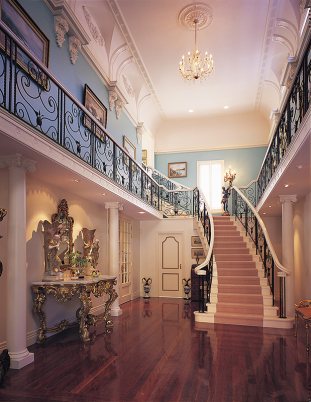
  • Can be seen as concentrating in the presence of the people who live in and use these rooms.


photo from here
Pattern
Photo by Stefan Jannides
Interior

photo from here
Small Detail


photo from here
Big View
photo from here Contrast


Monday, January 10, 2011

Architecture In Class Notes

  • Architecture photos are indirect portraits.
  • Materials, style and scale provide clues to what people's lives were like
Architecture is good for photography because;
  • Building's history
  • Different angles and perspectives
  • Doesn't change
  • Only raw photographic materials needed to make it
  • Designs in architecture coinside with those of photographic elements and principles.
Frederic H. Evans
  • One of the greatest architectural photographers
  • Focused on catherdrals in London
  • Depicted emotions with the use of lighting
  • Primarily used platinum paper and when the paper became scarce because of WWII he gave up photographer forever, rather than change is artistic process.
Architecture uses a lot of pattern and repetition.
3 types of architecture shots
  • Big picture
  • Small detail
  • Interior
Ezra Stoller
  • Focused on using line, shape and form
  • Started out as an architect, but switched to photography
Patterns dominate almost all architectural photos.
Important to communicate the personality of the space and its relationship to its surroundings in architectural photography.

Thursday, January 6, 2011

American Photography Video Notes

  • Illustrated Daily News first publication to sell itself based on photographs.
  • Want a photograph on the first page that is big, loud, draws immediate appeal on the front page
  • Wants a picture that draws emotion to attract attention and get people to buy the newspaper.
  • Composograph- pose the photographs using staff and later pasting in the faces of the real stars. Used in the Evening Graphic.
  • In photography truth always loses out to fantasy.
  • Photograhps helps advertisers give appeal to their products, people think photgraphers are more believable than drawings.
  • Camera's give ordinary objects and make them seem extraordinary, helpful in advertising.
  • Advertisements are no longer read, they are seen, they revolve around a photographic means.
  • Photography added a new dimension to fame, created the new media celebrity (these people look good in pictures)
  • Twentieth century astronomy would be unthinkable without photography, would neutralize anything from the picture that one's imagination would create.
  • Photography has enabled our five senses to be broadened.

Sunday, November 28, 2010

Baraka

When I first heard that this movie would be silent I was baffled; thinking to myself "how are we supposed to know what this movie is about if there aren't any words?" After watching about the first five minutes I started to understand. I also started to become enthralled by the scenes being played before me. I especially enjoyed viewing the tribal chant and the traffic scenes that were played with an accompanying beat. One scene that I wasn't particularly fond of was the baby chick factory. I tried not watching so I am not completely sure of what exactly happened there.

After watching the majority of the film, missing about the last ten minutes, I feel that it was a documentary of the different cultures of the world. Showcasing the life different people lead and how different cultures lead out their lives. Certain scenes were powerful, like the chanting scene, which left goosebumps on my skin. Others were disturbing, while others scenes were simply nice to take in for the beauty they offered.

I enjoyed seeing the lives of many different cultures and I am happy that the director decided to include such a vast array of cultures. I noticed during the film that the rule of thirds and space was used frequently. However, after awhile I stopped trying to look for photography principles as I became more and more enthraled with the what I was watching. Overall, I enjoyed the movie immensely and wished I would have gotten to see the ending; however, I couldn't stay the extra time after class.

Friday, November 19, 2010

Crepe Sale & Club Officer Meeting


Notes p. 114-125

Environmental Portrait
An environmental portrait tells a person's story with the use of the surroundings in a photo.
Picture taken from here

Self-Portrait
In a self-portrait you become you own subject. This is a chance for a person to reveal as much or as little of themselves as they choose. It can relate to your life, or who you are as a person. You also choose the setting. In its essence it is about yourself.
Picture taken from here

Lighting for Formal Portraits
Outdoor Lighting
When working outdoors direct sunlight can be harsh; therefore, not making it the most suitable source of lighting in pictures. Shooting in open shade, such as shadows from builings or trees can help filter the light and make the subject more comfortable.
Photo taken from here